You begin with a simple goal: learn UI/UX without stretching your budget. Then the search gets complicated. One course is inexpensive. Another offers live classes. A third includes certification, while another provides career support.
Suddenly, budget is no longer just a number.
The smarter way to approach the best online courses for learning UI UX from scratch is to consider three budgets together: money, time, and attention.
The idea matters because skills are changing quickly. The World Economic Forum reports that 39% of workers’ core skills are expected to change by 2030, while 59 out of every 100 workers are projected to need training or upskilling.

Budget One: Money
Picture yourself comparing course pages. Prices range widely, and every option appears to promise something different.
Instead of asking, “Which one is cheapest?”, ask:
“What can I realistically afford to invest in learning?”
Your money can support:
- A structured learning path
- Practical learning resources
- Guidance when you get stuck
- A consistent learning environment
- Career-focused support when you reach that stage
That distinction separates affordable learning from simply low-cost learning.
For learners exploring Affordable UI UX design courses with certification, certification can be useful when it supports a genuine goal. Still, the credential should sit within the overall learning experience rather than become the only reason to choose a program.
Budget Two: Time
Money gets counted immediately. Time often gets underestimated.
A course can look perfect while requiring more weekly hours than you can consistently give. That mismatch can make even a strong learning resource difficult to complete.
Look at your real schedule.
Maybe you have one hour after work. Perhaps weekends are your main opportunity. Either way, the best online courses for learning UI UX from scratch should fit your actual routine rather than an imaginary schedule.
A practical week could include:
- 2 hours learning
- 3 hours applying
- 1 hour reviewing
- 1 hour exploring questions
The numbers can change. The principle is not: choose a learning format your life can sustain.
Budget Three: Attention
Here is the budget most beginners forget.
Attention.
You can access thousands of lessons and still struggle if you constantly switch between resources.
LinkedIn’s 2025 Workplace Learning Report found that 91% of learning and development professionals agree continuous learning is more important than ever for career success.
Continuous learning does not mean consuming everything available.
A structured program can reduce the mental load of deciding what to study next. Your attention can instead move toward understanding, practicing, and asking better questions.
That is particularly relevant when comparing Top-rated UI UX design training programs for beginners. Ratings can be useful, but the real question is whether the format helps you stay focused.

The Three-Budget Test
Before choosing among the best online courses for learning UI UX from scratch, score an option against three questions.
Money Test
Can you comfortably afford it without unnecessary financial pressure?
Time Test
Can you complete and practice consistently alongside your responsibilities?
Attention Test
Does the structure help you focus, or will you spend most of your time deciding what to study?
The strongest option is the one that works across all three.
An Affordable UI UX design courses with certification program can be worth considering when the certification fits your objective and the learning structure also works with your time and attention.
Likewise, Top-rated UI UX design training programs for beginners should be evaluated through usefulness rather than popularity alone.
What Should a Beginner’s Budget Actually Buy?
A limited budget does not need to purchase every resource you discover.
Start with a foundation. Build a routine around it. Then use additional resources only when they solve a specific learning need.
A sensible budget can prioritize:
- Foundation — understand essential UI/UX concepts.
- Tools — develop confidence with digital design tools.
- Practice — turn lessons into actual design work.
- Guidance — get support when independent learning reaches a roadblock.
- Career development — connect learning with professional preparation over time.
This is also where UI UX design training with job placement assistance can become relevant. Career assistance can provide direction during the transition toward professional opportunities, while the learner still needs to build the underlying capability.
Where UI UX Growth Lab Fits
A budget-conscious learner does not have to treat structured learning as a compromise.
UI UX Growth Lab can support this three-budget approach by bringing several learning elements into one structured path. Its training resources include Figma, practical projects, portfolio development, accessibility, and case-study work.
That combination matters because your budget is not only purchasing lessons. You are creating an environment in which money, time, attention, and practice can work together.
For someone specifically seeking UI UX design training with job placement assistance, career support can sit alongside the learning journey. UI UX Growth Lab’s career-focused resources also cover real projects, portfolio building, interview preparation, and career support.
The goal is not to replace effort. Rather, structured support can create a clearer bridge between developing skills and preparing for opportunities.
A Better Way to Think About “Best”
The phrase best online courses for learning UI UX from scratch sounds like it should have one universal answer.
It doesn’t.
Your best option depends on what you can sustain.
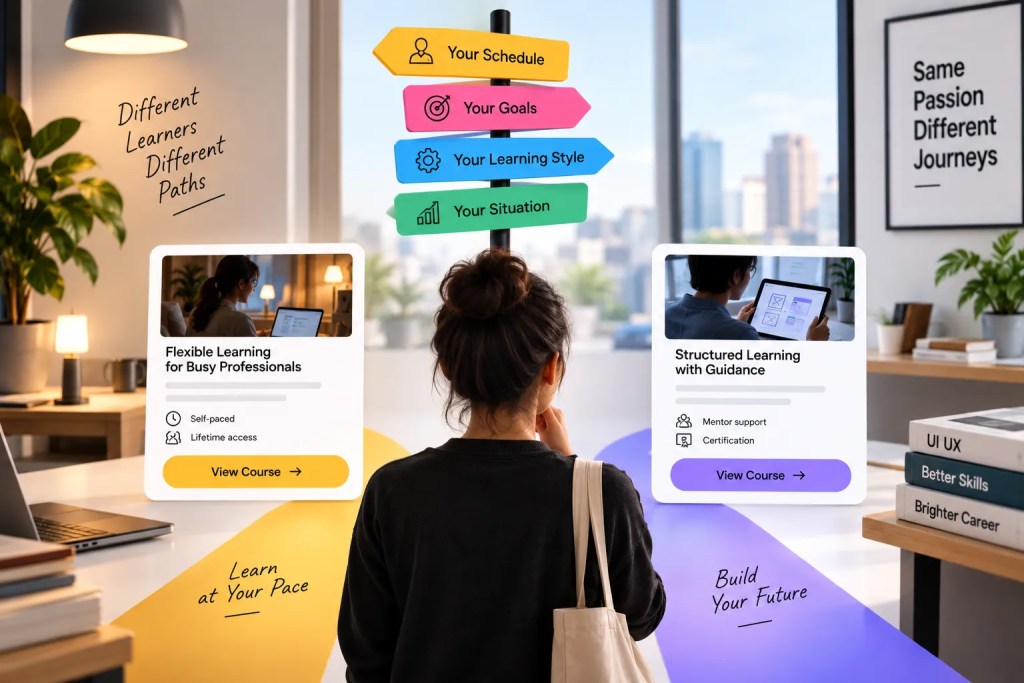
Someone with evenings available may value a different format from someone with only weekends. A learner who needs structured progression may choose differently from someone who already knows how to organize independent study.
That is why Affordable UI UX design courses with certification should be judged in context.
The same applies to career support. A useful program should fit the learner’s actual circumstances rather than forcing every beginner into the same learning pattern.
The Real Return on a Learning Budget
A successful budget does more than prevent overspending.
It protects consistency.
The World Economic Forum reports that 85% of employers surveyed plan to prioritize upskilling, while 63% identify skills gaps as a major barrier to business transformation.
That makes continuous skill development increasingly relevant. Your investment does not have to be enormous; it has to be sustainable enough to keep producing learning.
Ultimately, the best online courses for learning UI UX from scratch are the ones that fit the learner behind the search.
Frequently Asked Questions (FAQs)
No. Price is only one part of the decision. Look at affordability, structure, time commitment, practice, and support.
It can be useful depending on your objective. An Affordable UI UX design courses with certification option becomes more relevant when the credential supports your specific learning or career goal.
No. UI UX design training with job placement assistance can provide career guidance and support, but learners still need to develop their skills and prepare for opportunities.
For Top-rated UI UX design training programs for beginners, prioritize a sustainable learning experience. The best fit is one you can afford, follow consistently, and actively apply.
Conclusion
The best online courses for learning UI UX from scratch are not defined by the lowest price or the longest list of features.
They are defined by fit.
When your money budget, time budget, and attention budget work together, you create a learning system you can actually maintain. That is the real advantage of choosing carefully on a budget.
UI UX Growth Lab can help bring that structure together through practical learning, tools, projects, and career-focused development. Explore the learning journey here: https://uiuxgrowthlab.com/what-you-will-learn/
So, challenge your projects. Question assumptions. Explore constraints. Consider what could break. Think about scale, dependencies, changing requirements, and situations that are easy to overlook.
Most importantly, remember that getting Google’s attention should not mean trying to create a “Google-style” portfolio. It means developing the kind of curiosity, adaptability, and system-level thinking that can help you approach challenging design problems with confidence.
If you want to strengthen those practical skills and understand what you should learn next, explore the UI UX Growth Lab learning roadmap and curriculum.
Stop Watching Tutorials. Start Designing for Real.
No coding. No confusing theory. Just practical UI UX skills, real projects, portfolio building, and mentorship that helps beginners become industry-ready designers.


Bidisha Sen
https://uiuxgrowthlab.comI’m a Lead UI/UX Designer and mentor with 3.5+ years of experience in UI/UX design. I transitioned into design after spending 5 years in IT business development, progressing from Business Development Executive to Senior Business Development Executive. Today, I combine my understanding of business, users, and design to help aspiring designers build practical skills and industry-ready portfolios.