Career Switch to UX Design: What Recruiters Actually Want to See
Changing careers can feel overwhelming.
Many professionals worry that years of experience in marketing, teaching, customer service, sales, or another field will become irrelevant the moment they decide to enter UX. Others hesitate because they believe recruiters only hire candidates with formal design degrees or years of industry experience.
Fortunately, that’s no longer the reality.
Today, companies are actively hiring professionals from diverse backgrounds because UX design isn’t just about creating beautiful interfaces—it’s about understanding people, solving problems, and improving digital experiences. Those are skills many career changers already possess.
If you’re considering a career switch to UX design, the biggest challenge isn’t your previous profession. Instead, it’s learning how to present your existing experience in a way that demonstrates your value as a future UX designer.
Throughout this article, you’ll discover what recruiters actually expect from career changers, which transferable skills can strengthen your application, and how to learn UI and UX design without feeling overwhelmed. You’ll also explore the best place to learn UI UX design for free and understand whether a learn UI UX design free course is enough to begin your transition confidently.
Skills-Based Hiring Is Growing
According to LinkedIn’s Workplace Learning Report, employers are increasingly prioritizing demonstrable skills over traditional career paths, making career transitions more achievable than ever before.
Why Are More Professionals Choosing a Career Switch to UX Design?
The way people build careers has changed dramatically over the last decade.
Instead of staying in the same profession for life, many professionals are exploring careers that offer continuous learning, creative problem-solving, flexible work opportunities, and long-term growth. UX design has become one of those attractive career paths.
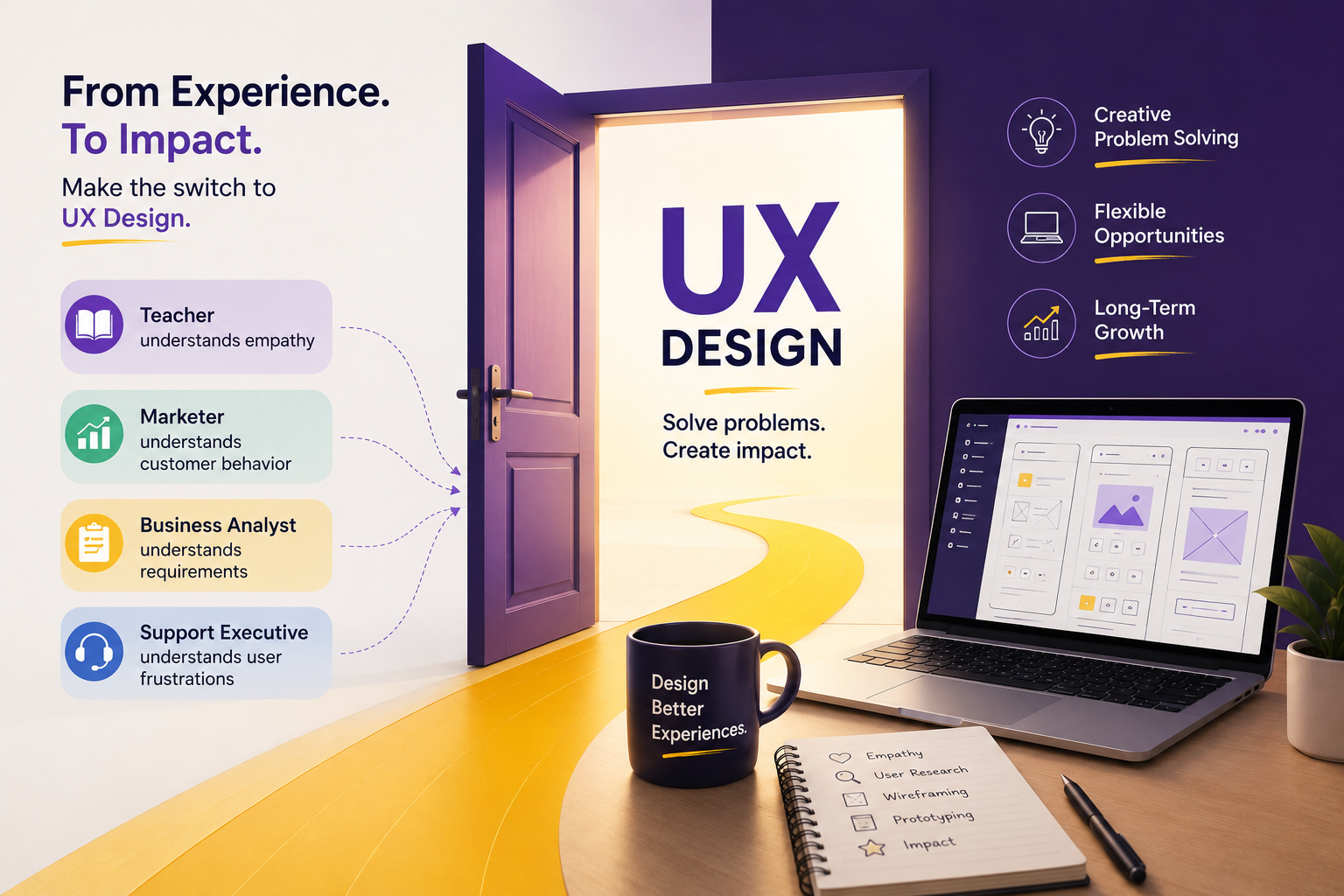
Unlike many technical roles, UX welcomes people from different educational and professional backgrounds. A teacher understands empathy. A marketer understands customer behavior. A business analyst understands requirements. A customer support executive understands user frustrations.
Each of these experiences contributes directly to better user-centered design.
Moreover, digital transformation has increased the demand for products that are intuitive, accessible, and enjoyable to use. Consequently, organizations need designers who can think beyond visuals and solve real business problems.
A career switch to UX design is no longer considered an unusual decision. Instead, it has become a practical choice for professionals looking to combine creativity with structured problem-solving.
What Recruiters Actually Look for During a Career Switch to UX Design
One of the biggest misconceptions among career changers is that recruiters expect them to compete with experienced UX professionals.
In reality, recruiters evaluate career changers differently.
Rather than comparing years of experience, they focus on potential, adaptability, and evidence of user-centered thinking.
When reviewing applications, recruiters typically assess:
- Problem-solving ability
- Communication skills
- Curiosity and willingness to learn
- Understanding of user needs
- Practical design projects
- Portfolio storytelling
- Collaboration experience
- Critical thinking
Interestingly, very few recruiters reject candidates simply because they worked in another industry.
Instead, they reject applicants who fail to explain how their previous experience connects to UX design.
That’s why your story matters just as much as your portfolio.
A successful career switch to UX design isn’t about hiding your previous profession—it’s about showing how it prepared you to become a better designer.
Your Previous Career Might Be Your Biggest Strength
Many career changers underestimate the value of the skills they’ve already developed.
However, UX design depends on abilities that professionals use every day, even outside the design industry.
For example:
| Previous Career | Transferable UX Skills |
|---|---|
| Teacher | Empathy, communication, research |
| Content Writer | Information architecture, UX writing |
| Marketing | Customer journey, user psychology |
| Sales | User needs, persuasion |
| HR | Interviewing, empathy |
| Customer Support | Pain point identification |
| Business Analyst | User requirements, workflows |
| Developer | Product collaboration |
Instead of starting from zero, most professionals already possess a strong foundation. The real challenge is learning how to apply those strengths within UX projects.
How Can You Present Transferable Skills Effectively?
Recruiters rarely expect career changers to know everything.
Nevertheless, they do expect candidates to explain their experiences clearly.
For example, avoid saying:
“I worked in customer support for five years.”
Instead, explain the value behind that experience:
“I spent five years identifying recurring customer pain points, analyzing feedback, and collaborating with teams to improve the user experience.”
Similarly, a content writer shouldn’t simply mention writing blogs.
Instead, they can highlight:
- Structuring information for users
- Improving readability
- Understanding audience behavior
- Conducting user-focused research
- Simplifying complex topics
Likewise, teachers can emphasize lesson planning, communication, empathy, and adapting content to different learning styles.
Consequently, recruiters begin seeing your previous career as an advantage rather than an obstacle.

Why Technical Skills Alone Won’t Help You Stand Out
Many aspiring designers spend months learning software.
Although mastering Figma is valuable, recruiters rarely hire someone simply because they know how to use a design tool.
Instead, they ask questions like:
- Why did you make this design decision?
- How does this solution solve the user’s problem?
- What research influenced your interface?
- Which usability issues did you identify?
- How did you validate your design?
Software teaches you how to design.
UX teaches you why you are designing.
Therefore, anyone planning a career switch to UX design should focus on developing product thinking alongside technical skills.
Learning tools without understanding users often leads to visually appealing interfaces that fail to solve real problems.
How to Learn UI and UX Design Without Feeling Overwhelmed
One of the biggest mistakes beginners make is trying to learn everything at once.
Fortunately, there’s a more structured approach.
Instead of jumping between random tutorials, focus on building your knowledge step by step.
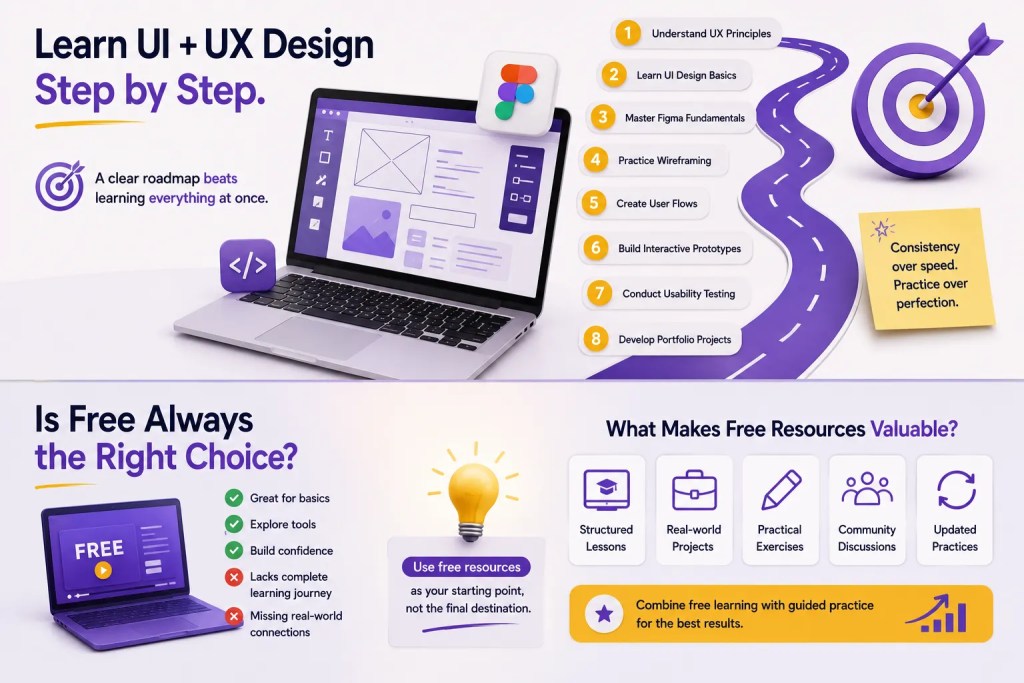
A practical learning roadmap includes:
- Understanding UX principles
- Learning basic UI design concepts
- Mastering Figma fundamentals
- Practicing wireframing
- Creating user flows
- Building interactive prototypes
- Conducting usability testing
- Developing portfolio projects
If you’re wondering how to learn UI and UX design, remember that consistency matters far more than speed.
Learning gradually while applying concepts through real projects helps you build confidence and retain knowledge more effectively.
Is the Best Place to Learn UI UX Design for Free Always the Right Choice?
The internet has made learning more accessible than ever before. Today, thousands of videos, blogs, and tutorials claim to teach UX design without charging a single rupee.
Although that sounds appealing, free resources aren’t always enough for someone planning a serious career transition.
The best place to learn UI UX design for free can help you understand fundamental concepts, explore design tools, and gain confidence before investing in structured learning. However, most free resources have one common limitation—they rarely provide a complete learning journey.
For example, you might find an excellent tutorial on wireframing but struggle to understand how it connects with user research or usability testing. Likewise, another creator may teach Figma shortcuts without explaining why a particular design decision improves the user experience.
Therefore, free learning should be viewed as a starting point rather than the final destination.
If you’re searching for the best place to learn UI UX design for free, look for resources that offer:
- Structured lessons instead of random videos
- Real-world design projects
- Practical exercises
- Community discussions
- Updated industry practices
- Constructive feedback
Once you’ve built a strong foundation, combining free resources with guided practice often produces much better results than relying on tutorials alone.
Can a Learn UI UX Design Free Course Help You Get Hired?
This is one of the most common questions among aspiring designers.
The honest answer is yes—but only to a certain extent.
A learn UI UX design free course can introduce you to UX fundamentals, design thinking, Figma basics, and interface principles. It allows beginners to explore the field before committing to advanced training.
However, recruiters rarely hire someone because they completed a certificate.
Instead, they evaluate whether the candidate can apply those concepts to solve real problems.
For example, imagine two applicants.
The first candidate completed five free courses but has no practical projects.
The second candidate completed one learn UI UX design free course, redesigned a local business website, documented the design process, and created a detailed case study.
Which candidate demonstrates stronger UX skills?
Most recruiters would choose the second candidate because practical experience speaks louder than certificates.
Consequently, treat every learn UI UX design free course as a stepping stone toward building meaningful portfolio projects rather than as the final goal.
Common Mistakes Career Changers Make
Changing careers is exciting, but it also comes with challenges. Fortunately, many mistakes are avoidable when you understand what recruiters expect.
Here are some common pitfalls:
- Waiting until you feel “perfect” before applying.
- Ignoring transferable skills from your previous profession.
- Copying portfolio projects from online tutorials.
- Focusing only on visual design instead of user problems.
- Building a portfolio without explaining design decisions.
- Learning software without understanding UX principles.
- Applying for jobs before receiving feedback on your work.
Instead, approach your transition as a continuous learning journey. Every project, critique, and improvement brings you one step closer to becoming a confident UX designer.

Build Credibility Through Real Projects
Recruiters know that career changers won’t have years of professional UX experience.
Nevertheless, they expect evidence that you can think like a designer.
You don’t need permission to start building experience.
Consider creating projects such as:
- Redesigning the website of a local business.
- Improving the user flow of a food delivery app.
- Creating an accessibility-focused interface.
- Designing a dashboard for a fictional startup.
- Solving a real problem you experience in everyday life.
After completing each project, explain:
- The problem you identified.
- Your research process.
- The decisions you made.
- The challenges you encountered.
- The final outcome.
As a result, your portfolio demonstrates your problem-solving ability rather than simply showcasing attractive screens.
Start Building Your UX Career with Confidence
If you’re serious about transitioning into UX, practical learning matters more than endless tutorials. At UI UX Growth Lab, you’ll work on real-world projects, build a recruiter-ready portfolio, receive expert mentorship, and develop the confidence needed to succeed in interviews.
Whether you’re just starting or refining your skills, you’ll learn by doing—not just by watching.
Explore our Beginner UI/UX Training and Advanced UI/UX Training
Frequently Asked Questions (FAQs)
A career switch to UX design requires dedication, continuous learning, and practical experience. However, professionals from many industries successfully transition every year by building strong portfolios and showcasing transferable skills.
The timeline varies depending on your learning pace. Most dedicated learners spend several months developing UX knowledge, completing projects, and preparing a portfolio before applying for roles.
If you’re wondering how to learn UI and UX design, begin with UX fundamentals, practice consistently, build real projects, seek feedback, and document your design decisions. A structured learning path is generally more effective than consuming random tutorials.
A learn UI UX design free course helps you understand the basics, but recruiters ultimately evaluate your projects, portfolio, and problem-solving approach. Practical application is far more valuable than collecting certificates.
The best place to learn UI UX design for free includes reputable educational platforms, official design documentation, UX communities, and quality YouTube channels. These resources provide an excellent starting point before moving to project-based learning.
Conclusion
Making a career switch to UX design isn’t about abandoning your previous experience—it’s about transforming it into a competitive advantage. Every profession develops valuable skills, whether it’s communication, research, empathy, analysis, or problem-solving. The key is learning how those strengths translate into user-centered design.
Rather than focusing solely on mastering tools, invest your time in understanding users, solving meaningful problems, and building projects that demonstrate your thinking. As you continue learning, remember that recruiters are looking for potential, curiosity, and evidence of growth—not perfection.
If you’re ready to accelerate your learning journey, choose resources that combine structured lessons with hands-on projects. With the right mindset and consistent practice, your career switch to UX design can become one of the most rewarding decisions of your professional life.
Stop Watching Tutorials. Start Designing for Real.
No coding. No confusing theory. Just practical UI UX skills, real projects, portfolio building, and mentorship that helps beginners become industry-ready designers.


Bidisha Sen
https://uiuxgrowthlab.comI’m a Lead UI/UX Designer and mentor with 3.5+ years of experience in UI/UX design. I transitioned into design after spending 5 years in IT business development, progressing from Business Development Executive to Senior Business Development Executive. Today, I combine my understanding of business, users, and design to help aspiring designers build practical skills and industry-ready portfolios.